Kingdom of Esfi
The Blazing WorldThe Kingdom of Esfi is the Empress’s native country and the political beneficiary of her expedition from the Blazing-World. Its threatened independence becomes the occasion for a campaign that moves from defense against enemy fleets to compulsory tribute and the subjection of nearly the entire world. The country’s ascent is presented as the restoration of its ruler’s hereditary rights, but its new supremacy depends on destructive force and control of commerce as well as on the Empress’s public claims of justice and divine favor.
Identity and Political Position
The Kingdom of Esfi is ruled by the King of Esfi, whom the Empress calls the sovereign of her native country. It is among several kingdoms under his authority, and the Empress describes him as possessing hereditary rights and prerogatives over the Narrow Seas. The narrative makes those claims central to her justification for intervening: she says the King has been unjustly attacked by multiple nations seeking to take those rights from him.
Before the campaign, the Kingdom of Esfi is not presented as the dominant power of its world. Its enemies remain strong enough to impede trade and traffic across the King’s dominions even after their fleets suffer defeat. The country’s position changes when the Empress offers further assistance, transforming military rescue into an undertaking to make its ruler the most powerful monarch in the world.
Defense and the Destruction of the Invading Fleets
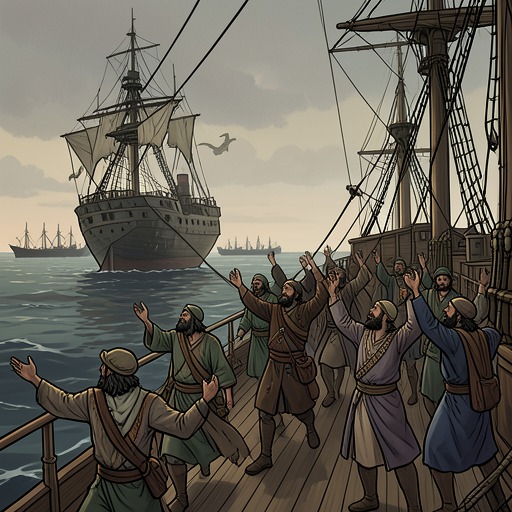
The Empress first sends Fish-men and Bird-men to gather intelligence about the enemy fleet, then uses fire-stones to unsettle its forces. At night, the Bird-men carry stones with their tips wetted, while the Fish-men hold similar stones above the water. In their thousands, the flaming devices make sea and air appear to burn; those nearby believe the Last Day has come and fall down to pray. At daybreak, the enemy sees ships without sails, guns, or other weapons, apparently moving by themselves. Their hulls are painted dark, concealing that they are made of gold, and the strange sight leaves the fleet unable to act.
While the enemy hesitates, the Empress sends a letter to its general and principal commanders. She identifies herself as a powerful princess who has come to assist the Kingdom of Esfi and asks them to declare when they want her aid. Their council cannot quickly agree on a reply because its members hold conflicting opinions. The Empress grows angry and threatens to return to the Blazing-World without helping; the Duchess of Newcastle persuades her to wait, pointing out that councils take time when many people contend to give the wisest advice.
When the fighting begins, the Empress appears on the water in imperial robes set with diamonds and carbuncles, carrying a shield made from a single carbuncle and a spear made from a single diamond. She directs the Fish-men to uncover and wet the fire-stones only when they are beneath or beside enemy vessels. The ships catch fire, and the flames reach their gunpowder; the enemy navies are destroyed in a short time. The people of the Kingdom of Esfi interpret the victory as miraculous deliverance, and the Empress does not intend to leave until the rest of the world has submitted to their nation.
From Rescue to Maritime Tribute
The naval general reports the victory and the Empress’s imperial design to the King of Esfi. The King thanks her for the rescue but explains that the remaining enemies still obstruct trade throughout his dominions. The Empress answers that she will burn and sink ships that refuse to pay him tribute. She demands payment from neighboring nations that trade by sea; when they refuse scornfully, she orders the Fish-men to destroy their ships. Faced with the destruction of their maritime commerce, the nations seek terms, but the Empress allows no alternative to submission and tribute to the sovereign of her native country.
The resulting settlement makes the King of Esfi master of the seas and, through dependence on trade by land and water alike, gives him mastery over that world. The narrative makes commerce the practical hinge between naval victory and political dominion: the Empress does not need to occupy every country before its rulers feel the consequences of her power. Control of shipping and access to trade turns the demand for tribute into a means of imposing submission.
The arrangement does not remain uncontested. After a short time, neighboring nations find themselves so burdened by tribute that they can scarcely move beyond their dominions without cost. They unite their forces against the King, but the Empress again sends the Fish-men to destroy what remains of their naval power. Most are forced back into submission. Nations able to live without foreign trade, and those whose commerce is conducted entirely by land, still refuse to pay; the Empress threatens to burn their towns and cities if they do not yield.
Conquest of the Resistant Nations
The Empress orders a campaign by Bird-men and Worm-men, initially limiting the target to smaller towns because she is reluctant to cause more destruction than she considers necessary. She has the Bear-men use their telescopes to identify the settlements that refuse submission, and her messengers warn the princes and sovereigns that resistance will turn a limited loss into total ruin. The Bird-men are ordered to fly at night. Worm-men can travel beneath the ground, making it possible to place fire-stones under the foundations of houses, while the Bird-men set others on rooftops.
The weapons exploit moisture to produce a seemingly impossible effect. The Bird-men tell the inhabitants that rain will set the towns on fire, a warning they laugh at because they expect water to quench flames. When rain comes, the houses catch fire, and more water makes the burning more intense. Terror spreads through neighboring cities, nations, and kingdoms, which submit to the King of Esfi rather than risk the same destruction.
One country remains outside the settlement because it receives little rain, relying mostly on dew. The Empress learns that it is flooded annually by a tide lasting several weeks, and orders the Bird-men and Worm-men to place fire-stones at the bases of the supports holding up its raised houses. When the tide arrives, the houses ignite; the heat turns the water into vapor and then air, destroying the buildings and causing a general barrenness throughout the country for that year. This final coercion secures its submission and completes the extension of the Kingdom of Esfi’s authority across the world.
Imperial Settlement and Its Contradictions
After saving her native country, the Empress has made it an absolute monarchy over the world. She presents the settlement to the princes not simply as the result of superior force, but as the correction of an injustice: heaven, she says, has rewarded the King for injuries suffered and made him the head monarch. Her speech urges the other rulers to pay tribute so that they may live peacefully and happily, while warning that resistance can bring loss without victory.
The public language of peace sits beside the means used to establish it. Fleets are burned, trade is deliberately ruined, towns and cities are threatened, and fire-stones are placed beneath houses so rain or a rising tide will set them ablaze. The Empress’s preference to begin with smaller settlements limits the initial scope of destruction but does not change the ultimatum: submission or ruin. The Kingdom of Esfi’s world-scale authority is therefore shown as both a promised order and a coercive hierarchy, with peace secured on the terms of its sovereign.
The Empress later gathers the princes at sea and again identifies herself as the King of Esfi’s supporter, describes his enemies as unjust aggressors, and insists that the other rulers cannot prevent his power. Her fleet then enters the circle formed by their ships and sinks beneath the sea, leaving the spectators amazed. The Kingdom of Esfi’s new status is thus enacted through ceremony as well as conquest: tribute is demanded in the language of rightful sovereignty, while the Empress’s spectacle makes the force behind that demand impossible to ignore.